|
Environmental Management System EMS 05-06 Clean drain tank- Issue and concern |
Doc No.: EMS-05-06 Revision: 0 Date: 15Apr 2023 Issued by: DPA Approved by: MD |
This circular is meant only for ships installed with Clean Drain tank / Clean Bilge tank which has inlets only from Air Cooler Condensate & other clean water/ drain sources as mentioned in Case A of this circular.
Please Note: These Clean Drain Tank/ Clean Bilge Tanks should have no Inlets from any of ER Bilge sources including discharges of ER bilge Pumps and from sources as mentioned in case “B” below.
The following key issues and concerns are being addressed herein:
- M.E Air Cooler Drain condensate and its disposal.
- Clean Drain Tank/ Clean Bilge tank dedicated for storing Clean condensate / clean Drain Water from sources mentioned in Case A below.
- Discharge of Condensate water / other clean water Drains directly Overboard by approved Piping and pumping system as per ship's design. Such class approved discharging arrangements can have a direct discharge possibility by dedicated pump / Fire & GS pump or a discharge through a standalone 15ppm OCM or a white Box arrangement as retrofitted.
- Seal Tagging of discharge system Piping flanges and Clean drain Tank Manhole.
- Recording of these discharges.
| Note:Following Case A and Case B are detailed to ensure clear understanding on sources of drains which can be drained into clean drain tank while others which should not be: |
1. CASE A
Ships with Clean Drain Tank/Clean Bilge tank with inlets of condensate/ drains ONLY from the following sources, can be discharged directly Overboard by approved permanent Piping/ pumping arrangements, subject to conditions mentioned in “Section 5” of this circular:
- ME Air Cooler Condensate drains directly into the Clean Drain tank/ Clean Bilge tank.
- Drains from Save-all of one or all of the below sources ONLY, can flow directly into the Clean drain tank through approved permanent piping: FW Expansion tank Tray save-all JCW Pump Tray save-all Feed-water Pump Tray save-all FW Hydrophore Pump Tray save-all Cascade Tank Save-all/ Drain Fresh Water Tank / Drinking water tank/ Distilled water tank Save-all & drains (If applicable) SW Pump Save-all drains (if applicable) CFW cooler Save-all (To Ensure No Cleaning Chemicals drains) FWG Save-all (To Ensure No Cleaning Chemicals Drains) Overflow from Sewage Treatment plant treated effluent Or Grey water as per ships design and approved piping
2. CASE B
Ships with Clean Drain Tank/ Clean Bilge Tank having Inlets from any one of following sources, will not be pumped / discharged directly overboard and must be transferred to a IOPP 3.1 Listed tank ( Eg WO tank/ FO Sludge Tank/ Oily Bilge tank etc). If the
- Any of the FO/ LO/ WO/ Hydraulic Oil Pumps and its save-all
- Drains from WO Settling/ Service tank and/ Or save-all of these tanks (If such exists, modification to be proposed for Class approval to divert to 3.1 tanks)
- Any of the LO/ WO/FO/ Hydraulic Oil/ Bunker Tanks Save-all
- Boiler / EGE and COP Trays/ Save-all
- Economizer wash water tank draining to Clean Drain or Clean Bilge tank
- Air Compressor/ Aircon Compressor/ Fridge Compressor Save-all
- ER Wash basin / Wash water/ Laundry drains (If such exists, modification to be proposed for Class approval to divert to 3.1 tanks)
- Diesel Generator save-all
- Steering Gear Room drains/ save-all
- Aux Boiler/ Economizer save-all
- Deck Hydraulic Machinery save-all
- Any other Save-all which has the possibility of Oil traces/ leaks
- Any unauthorized drains/ entries made by Flexible Pipe/ Portable pumps OR through any other temporary piping’s drains into the Sounding pipe etc.
3. RECORDING REQUIREMENTS
1) Clean Drain Tank/ Clean Bilge Tank: Non IOPP Tank: When Clean Drain Tank/ Clean Bilge tank is not a part of IOPP, its contents received only from sources as mentioned in case A, then same can be discharged directly overboard through approved fixed piping and pumping system with or without dedicated 15ppm OCM (as per design) and such discharge recorded as follows in Engine Log book:
“ xx M3 of Clean Condensate water discharged from Clean Drain tank (or Clean Bilge tank) on xx/xx/xx from xx:xx hrs to xx:xx Hrs. Tag seal number xxxxxx broken and new tag seal no xxxxxx installed on the Overboard valve. Sign CE/ DE”
Seal Log will require entry in E81 for breaking of seal and renewal of seal on the Overboard Discharge valve.
2) Clean Drain tank/ Clean bilge tank in IOPP: If the tank is a part of IOPP, then such collections must be discharged only through Oily water separator. Recording must be made then in ORB-Part 1 as D 13/14/15.1
3) If the Clean Drain Tank/ Clean Bilge tank is not in IOPP and receives drains from sources as mentioned in In Case B,then the tank contents will require to be transferred mandatorily to IOPP 3.1 listed Waste Oil tanks for evaporation and/ or incineration. Such transfers may require Portable pump and flexible hose permission (Tech Superintedent) unless ships piping design allows by dedicated fixed pump. In such case following should be followed for recording:
Transfer from the Clean Drain tank/ Clean Bilge tank (Non IOPP) to one of 3.1 Listed Bilge tank will be recorded as below:
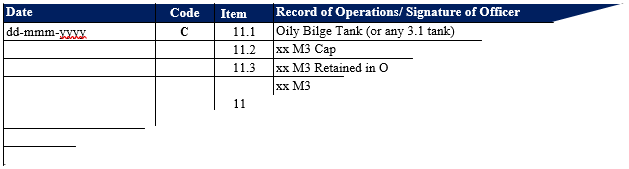
Thereafter disposal from the 3.1 listed tanks to be done by Evaporation/ Incineration/ Landing to Port reception (as case may be) and relevant entry be made in ORB as per MEPC 736 Rev2.
4. CHECKS PRIOR DISCHARGING
| Caution:All the 3.1 listed IOPP tanks must have their vents leading to open deck/ funnel deck/Mist box open atmosphere and NOT open in ER. |
Following arrangements/ verifications must be done by Ship-staff:
- Only approved piping and designated pump/approved piping with eductor to be used for pumping contents of this tank directly overboard.
- The original approved piping for drains from above sources as in Case A leading to this tank should not have any modifications/changes from the original design. Any blank flanges in the inlet lines (if any) or discharge lines to be seal tagged and entered in E81 seal log.
- The Clean Drain tank should have a dedicated discharge pump which should not receive from any of the other sources, e.g., ER Bilge system (tanks/piping/bilge pump) and/or any other source.
- The Clean Bilge Tank Direct Discharge Overboard valve is shut & seal tagged, padlocked, and the same entered in the E81 Seal Log. The tag to be broken only when discharging contents of this tank.
- The manhole of the clean bilge tank/clean drain tank to be tagged on two diagonally opposite securing nuts/studs.
- The Clean Drain tank content must be inspected once every 6 months by opening the manhole to confirm no oil sheen/oil ingress.
- The discharge pipe flanges on the overboard line to be seal tagged and entered in the E81 Seal Log.
- USCG Anti-Pollution Notice / Company Poster to be pasted near the Overboard valve at a conspicuous location with a notice: “Do Not Open without CE Permission.”
5. CLEAN DRAIN TANK DISCHARGING
For every time the Clean Drain Tank is discharged, the following criteria must be fulfilled:
- The discharge is notified to the Master & authorized by the CE after he has verified that inlets to this tank are from Case A.
- The suction valve from this tank (in case of eductor system by Fire & GS pumps) or the overboard discharge valve, the key must remain with the CE.
- The ship is en-route (speed at least 6-8 knots) and not in a special area.
- The ship is at least 24 nm from the shore (Bridge to be confirmed prior such discharge).
- Oil finder paste is used to check the presence of oil prior to the start of discharge. In case of doubts, the manhole is to be opened, checked, and CE to decide whether to abort or proceed.
- The Bridge is notified of the discharge, and intermittent visual checks are done.
- 15 ppm OCM (as applicable for ships fitted with the same) is in operation during the discharge.
- Operation is performed in daylight hours and in ER manned condition.